Yet another entry in the next-gen supersonic sweepstakes, but you’ve got to admit this looks sweet:
Credit: JAXA
The market for civil aircraft – both airliners and private – seems pretty full to me. If a Japanese manufacturer wanted to shake up the competition, this would be the way to do it.
Unfortunately I’ve not been able to find any more information beyond what’s already at the link – which is a mite thin to begin with. It’s not clear how they plan to conduct the test flights, if it’s a powered drone then that’d be Teh Awesome. The alternative would be mounting it to a fighter that can zorch around at Mach 1.0+…not as cool, but perhaps more useful than wind-tunnel testing. Either way let’s hope this makes it somewhere beyond the model-airplane stage.
It’s entirely too quiet around here, so let’s do something about that:
I’ve finally got Red Bull’s marketing strategy figured out: hire crazy people to jump off of really high stuff. Or high people to jump off crazy stuff – might not make much difference.
Not that I’d do anything that nuts, but if I ever did it’d have to be dressed as Batman. Because BATMAN!
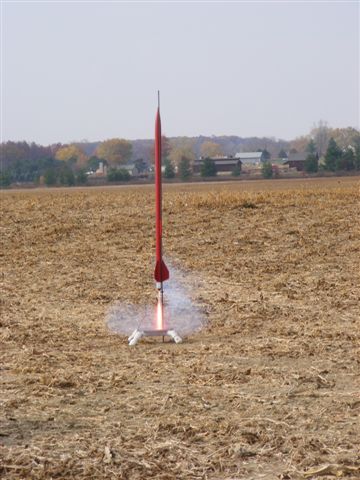
When deciding to become a novelist while keeping the day job – sadly necessary if you also choose to live in a house and eat food – you have to be willing to give up most of your hobbies, or at least the most time-consuming ones. In my case, that was modeling and high-power rocketry (HPR, for the uninitiated).
HPR is the grown-up version of the ubiquitous Estes model rockets some of you might have toyed with as kids. Typically the rockets are big enough, and engines powerful enough, to require FAA waivers which close the airspace to conflicting traffic. You also have to go through a certification process with one of the national hobby organizations.
“Red Death”, headed for 6,000′ AGL and Mach .90, never to be seen again.
If you’ve been hanging out at this blog for a while, you know I’ve been a rocket and space geek since I was a little kid watching Apollo missions on the old black-and-white TV. When I discovered high-power about ten years ago, it hooked me completely. Better Half was less excited but she at least tolerated it. And to be fair, it’s not cheap: the cheapest motors are around twenty bucks each, and that’s if you’re using a reloadable system which means you’ve already forked over a hundred for motor casings. Throw in medium- to high-tech materials (fiberglass, composites, etc) and electronics (those parachutes don’t deploy themselves at 10,000′) and stuff gets spendy in a hurry. I built a couple of fiberglass rockets and one partially with composites, and that’s about as techy as it got. Perhaps if I’d invested in an altimeter-controlled recovery system, I’d still have Red Death instead of it being carted off by winds aloft somewhere into the next county.
This project, on the other hand, looks to be a bit more complicated.
It’s essentially an open-source Mercury/Redstone vehicle, taking advantage of modern building materials and 50-odd years of acquired knowledge. If you’re looking for a challenging build, this might be it.
This looks cool, but I wouldn’t get into a twist over it just yet. Remember the Sonic Cruiser? That was an actual development program (which eventually morphed into the decidedly less-sexy 787) whereas this is still just R&D. Not to say it won’t go anywhere, but don’t look for any Mach-busters in spiffy airline paint anytime soon.
A little closer to home, there are still ways to squeeze serious knots out of a piston single, and most of them are downright gorgeous. Though if you’re not into racing, there’s always this little beauty:
The Pipistrel Panthera. Now wipe the drool off your keyboard.
The limiting factor in terms of my own future enjoyment? Regulations, which equals money. Lots of it. The process for certifying a new aircraft design is so cumbersome that it easily doubles – maybe even triples – the price of a finished product and takes it well beyond the reach of normal people. Even a mundane little Cessna 172 costs well north of a quarter million dollars new. That’s like buying a Lamborghini. Does anyone really believe a design that’s more than half a century old is worth three hundred large?
< crickets chirping…>
Thought so.
Granted, production airplanes should be expected to cost more because they need to be a great deal more reliable than cars. But when the regulatory hoops push even a simple light-sport design into six-figure price tags, something is seriously out of whack.
This is why there’s been such a boom in homebuilt aircraft kits over the last 20-odd years: no doubt many builders wouldn’t have it any other way, but I’m certain a sizeable fraction are in it to get a hot plane for less money. At least the ones I know are, even though we’re still talking a fair amount of dough for a project that can easily take 5+ years. That’s a commitment I have a hard time getting my head around, and this is coming from a guy who writes novels. At least my finished products don’t have the potential to kill me if I screw them up.
Hopefully relief will be coming in the next couple of years. As one who’d dearly love to someday fly something like this, I can only hope.
SpaceShip Two finally had its first powered flight today, passing Mach 1 with a 16-second burn of its solid/liquid hybrid engine. The jury’s still out as to how much of a safety advantage that may be, but it sure does look cool:
To infinity and beyond!
As they say, a picture is worth a thousand words. And video is worth even more:
UPDATE: In more mundane aerospace news, Boeing’s 787 is finally returning to service. That program’s been a massive Charlie-Foxtrot from the beginning, but I do have high hopes for this bird.
After being alternately busy, sick, and/or otherwise occupied, it’s time to catch up with blogworthy stuff. And since NASA’s apparently spending our hard-earned money etching pictures of their junk into the Martian dirt, maybe it’s time we caught up with what’s happening in the serious space industry…
Next up: SpaceX keeps raising the bar with the latest Grasshopper hover test. This time it hovered over 800′. Word is their next ISS mission will demonstrate 1st-stage return – no plans to actually land the thing, but they’ll work out the guidance and powered descent techniques to at least plant the thing where they want in the Atlantic.
Next-next up: Virgin Galactic plans to make SpaceShipTwo’s first powered flight next Monday, and figures they might as well go supersonic while they’re at it. It might just be more trademark Branson Bluster, but if so that particular horse is already out of the barn. It’ll either happen or it won’t. I can’t recall if SpaceShipOne did that its first time under power, but once that motor’s lit it’s a mighty short trip to Mach 1.
Not to take their thunder away (okay, maybe I am), but Michael Belfiore visited XCOR Aerospace and posts this profile. I hope both they and Virgin are successful, but have to admit I prefer XCOR’s approach as a more useful long-term system.
Finally: any good movies coming out? Darned if I can think of any…
Once you go green, you never…whatever rhymes with green.
If NASA’s Space Launch System ever moves beyond “Powerpoint Engineering”, it might just do so with an update of the massive F1 engines that powered the Saturn V. If Uncle Sam’s gonna throw my hard-earned tax money down a hole anyway, then I’m cool with this particular hole:
America: doing impossibly awesome $#!+ since 1776.
Even though the performance goals of the engine will be close to its predecessor, its manufacturing will be done through radically different methods. The Dynetics folks echoed Betts, Case, and Coates when reflecting on the F-1’s construction, making many of the same observations about the jaw-dropping amount of hand-done work in the old design. In the name of affordability and efficiency, modern manufacturing techniques will be brought firmly to bear on the new version.
Each Pyrios booster will feature a pair of F-1B engines, built with techniques that more resemble 3D printing than traditional casting or milling. The main combustion chamber and nozzle in particular will undergo tremendous simplification and consolidating; the parts count for those two assemblies together will be reduced from 5,600 manufactured elements in the original F-1 down to just 40.
Emphasis mine.
I have my doubts that this particular pig will ever fly, but if it leads to some serious R&D to perfect and cheapen an already heart-stoppingly powerful engine, then so much the better. With licensing and whatnot, somebody is bound to put it to good use.
Two of my favorite guitarists, Jeff Beck and Billy Gibbons, covering a classic Hendrix tune:
His bass player is no slouch either, a true prodigy.
P.S. I modded my ’73 Les Paul maybe 20 years ago with Seymour Duncan JB and Pearly Gates pickups, which were designed for the above-mentioned gentlemen. That thing might feel like a cinder block hung around my neck but it’s got tone to die for.
All shall wonder and despair, for the One Ring has been found!
The ring is believed to be linked to a curse tablet found separately at the site of a Roman temple dedicated to a god named Nodens in Gloucestershire, western England. The tablet says a man called Silvianus had lost a ring, and it asks Nodens to place a curse of ill health on Senicianus until he returned it to the temple.
An archaeologist who looked into the connection between the ring and the curse tablet asked Tolkien, who was an Anglo-Saxon professor at Oxford University, to work on the etymology of the name Nodens in 1929.
Since I’m not nearly as smart as Tolkien was, I simply Googled “Nodens” to see what turned up. It had also attracted the attention of seminal horror writer H.P. Lovecraft:
And upon dolphins’ backs was balanced a vast crenelate shell wherein rode the grey and awful form of primal Nodens, Lord of the Great Abyss… Then hoary Nodens reached forth a wizened hand and helped Olney and his host into the vast shell.
—H. P. Lovecraft, “The Strange High House in the Mist”




 The ring is believed to be linked to a curse tablet found separately at the site of a Roman temple dedicated to a god named Nodens in Gloucestershire, western England. The tablet says a man called Silvianus had lost a ring, and it asks Nodens to place a curse of ill health on Senicianus until he returned it to the temple.
 The Chiles Files