While the rest of us were laying around on our butts watching football, the geeks were busy inheriting the Earth…or rather the sky above us.
Orbital Science’s Cygnus cargo spacecraft docked with the International Space Station, making it the second commercial launch provider to do so:
Cygnus berthing at the ISS
Meanwhile, the first commercial operator to reach the ISS flew their upgraded Falcon 9R launcher out of Vandenberg AFB in California. This was a number of firsts for SpaceX: first flight of the 9R, first all-commercial payload, and first relight of a booster in a controlled re-entry:
Falcon 9R
That last bit is by far the most significant — it’s the key to SpaceX’s plans for reusable rockets, which is the key to lower launch costs, which is the key to the rest of us being able to afford a trip to orbit (or even farther) some day.
The goal is to eventually return the first stage of an operational Falcon 9 (and later, when it flies, the three cores of the Falcon Heavy) to the launch site, and reuse them.
Sunday’s flight test on an ostensibly operational mission was less ambitious. The goals were to see if 1) they could get the vehicle back into the atmosphere in one piece with the first burn (all previous Falcon 9 uncontrolled first-stage entries have been destructive) and 2) if they could gently drop it into the ocean with the thrust of a single engine, and recover it. The company has emphasized repeatedly over the past several months that this was not part of the primary mission goal, and that they didn’t have high expectations of success.
As it turned out, they seem to have succeeded at their first test goal, but failed the second…
Despite the recovery failure, company founder and CEO Elon Musk seemed very optimistic about the results.
The above is clipped from Rand Simberg’s authoritative roundup at PJ Media. Interestingly, DARPA and McDonnell Douglas made some significant advancements along these lines 20 years ago with the Delta Clipper Experimental (DC-X). Made on the cheap with a good deal of off-the-shelf parts, they managed several successful flights until the project was transferred whole-hog to NASA:
DC-X, first hover landing
NASA agreed to take on the program after the last DC-X flight in 1995. In contrast to the original concept of the DC-X demonstrator, NASA applied a series of major upgrades to test new technologies…
The upgraded vehicle was called the DC-XA, renamed the Clipper Advanced/Clipper Graham, and resumed flight in 1996.
…Its next flight, on 7 July, proved to be its last. During testing, one of the LOX tanks had been cracked. When a landing strut failed to extend due to a disconnected hydraulic line, the DC-XA fell over and the tank leaked. Normally the structural damage from such a fall would constitute only a setback, but the LOX from the leaking tank fed a fire which severely burned the DC-XA, causing such extensive damage that repairs were impractical.
In a post-accident report, NASA’s Brand Commission blamed the accident on a burnt-out field crew who had been operating under on-again/off-again funding and constant threats of outright cancellation. The crew, many of them originally from the SDIO program, were also highly critical of NASA’s “chilling” effect on the program, and the masses of paperwork NASA demanded as part of the testing regimen.
NASA had taken on the project grudgingly after having been “shamed” by its very public success under the direction of the SDIO.
Read the whole entry at Wikipedia for a case study of what happens when a willingness to take risks is swallowed up by ass-covering bureaucratic inertia. Surprising? Sadly, no…but at least the commercial camel’s nose is now all the way up in NASA’s government tent and sniffing at their junk.
From across the pond, the UK Daily Mail on plans to turn Houston’s old Ellington Field into a commercial spaceport:
The city announced yesterday that it had applied for a licence to build the United States’ latest and biggest spaceport, and has already drawn up a detailed proposal of what the state-of-the-art facility would look like if it gets the green light.
The spaceport, which would be built on a 450-acre site that is currently home to the US military and NASA operations at Ellington Airport, would include a sleek passenger terminal and an aviation museum.
The white zone is for loading and unloading…
Plus some spiffy pictures from the Houston Airport Authority. Observant readers will note a couple of Boeing Sonic Cruisers mixed in with the SpaceShipTwos and Orbital L1011 launchers. Really observant readers will see an old B727 in the far background, which I assume represents ZeroG’s “vomit comet” franchise. Didn’t see XCOR or Stratolaunch represented, but it’s just concept art so no reason to get in a twist over it. And to be honest, municipal airport authorities tend to be booster-ish: that is, real good at coming up with grandiose plans that never see the light of day…and when they do, they’re often based on shaky economics. Though I did like how they hope to eventually host “international” spaceflights, which I take to mean the kind of point-to-point suborbital concepts of which I’m a bit of a fan.
It’d be nice to see all this come to pass, but there are a lot of other things that need to happen first. Namely, spaceplanes need to start showing up en masse.
…Nature’s way of asking, “How’s that space program coming along?”
I reckon the answer to that particular question depends on where you’re looking.
Turns out that last winter’s big explode-y meteor over Russia may have come from a whole pack of big explode-y meteors. Which means we could stand a good chance of running into some of his buddies one day.
If that doesn’t bother you enough, there’s always this handy little graphic of all the potentially civilization-ending rocks lurking out there:
The UK Telegraph ran a story today about the private efforts to send people to Mars. Nothing really new here for anyone who follows this stuff, but it’s interesting to me that this is being treated seriously by the popular media and not just other space fanboys.
But if we’re going to do stuff with the potential to be suicidally dumb, we’d better get serious about our spacefaring capabilities. Those Star Destroyers aren’t going to build themselves.
Is there intelligent life out there? Beats me. I tend to doubt it, but that’s only because of my Christian faith. It’s not a concept that I take all that seriously, though it wouldn’t be a shock if there’s other life out there – finding microbes on Mars or sea creatures on Europa wouldn’t be any more theologically jarring than finding a new species at the bottom of the Arctic Ocean.
Finding sentient life would be an entirely different matter, and I have to admit it would shake me to my foundations if it happened. And I like to think of myself as a fairly open-minded guy: I’ve made peace with the concept of evolution alongside the creation story in Genesis. My God is big enough, and science can’t explain everything. A lot of fellow believers haven’t reconciled themselves with that – too many, in fact, have blown off science entirely because it challenges their belief system and they just don’t want to have to think about it.
Presuming there is intelligence out there, how can we be sure they’d be good neighbors? I never bought into the starry-eyed presumption that the only way a civilization could make it that far was through peaceful coexistence, because anything else would have surely resulted in their annihilation.
Real scientists will no doubt tut-tut my ignorance but it seems to me that if there are other civilizations in the universe, there’s only a few reasons we haven’t heard from them:
1. They’re really that much smarter than us and don’t think we’re ready for it.
2. They’re no smarter than us and haven’t been broadcasting for long enough.
3. They’re smarter than us and know the neighborhood’s not safe, so shut up already before you attract any more attention to yourselves!
The first time I read about hypothesis (3), I was stunned that it hadn’t been advanced earlier: what if everyone who can communicate doesn’t because there’s a really good reason not to? Should we be carrying on like we’re in the ol’ Griswold Vacation Wagon, broadcasting our suburban-honky naivete to all the gang-bangers within earshot? Because if predators count on anything, it’s the prey’s ignorance that they’re being stalked.
Of course, I’m always looking for reasons to stock up on ammo.
Private missions to Mars are attracting more and more attention from the serious press. Here’s a clip from a piece today in The Economist discussing Dennis Tito’s Inspiration Mars project:
Even if everything does go according to plan, though, cynics might question the value of a billion-dollar, one-and-a-half year trip that comes within spitting distance of Mars but does not land. Dr MacCallum points out that even a fly-by would generate a great deal of publicity. “It would be a [Charles] Lindbergh” mission, says Dr Zubrin. “The point would be to prove it can be done.”
Exactly. Sometimes you just have to kick the tires and light the fires if you want to get things done. A privately bankrolled mission doesn’t have to fine-tune every aspect of it to please capricious politicians (who could really give a crap) and a skittish public (in reality, a skittish and hyperventilating press but you get my drift). That is, treating safety itself as if it’s the overall goal while at the same time making it such a bloated do-it-all attempt that nothing gets done except burning up a few billions on Powerpoint Engineering.
Really…what was the last manned spacecraft development program that NASA successfully completed? Hint: we just stopped flying them last year. And I’m defining “successful” as “a completed vehicle that managed to fly.” Anyway, it appears The Economist’s editors have a similar take on things:
It is entirely possible—likely, even—that neither of these missions will happen. Mr Tito has the better chance, but there are many more ways for him to fail than to succeed. Mr Lansdorp’s plans look too ambitious to be credible. And NASA’s recent history suggests that its aspirations, too, will be blown off course by a future president. But all this will not deter true believers, who have been discussing how to run a Mars trip for decades. With the cost of space flight lower than ever, it seems unlikely that the dream will die.
First test of the Falcon 9 reusable first stage. Credit: SpaceX
Boeing, meanwhile, is still plugging away on their CST-100 system. And I hate to say it, but of all the commercial crew projects out there this one might be the least likely to succeed – and it has nothing to do with design or expertise. Rather, it’s all about The Borg’s commitment to private space. Personally, I just don’t think it’s there. They’ve made comments before about not being able to close the business case – or even being all that interested in trying to – if the funding dries up. That cost-plus contractor legacy must be hard to shake, considering NASA’s money is chump change when compared to Boeing’s resources. Of all the CCDev projects, they could certainly afford to throw the most money at it without hurting the company.
As the big dinosaurs fight over their food supply, smart little mammals stay out of their way and just keep doing what they do. In the meantime, here comes the asteroid…
Wow. Who knew aerospace had so much in common with publishing?
The latest issue of Air & Space (which still has yet to run the article they paid me for!) follows up on the post-shuttle careers of a few NASA engineers. Ordinarily of interest to me, but not compelling, until I came to this guy’s story:
Perry Lewis, a former Johnson robotics flight controller, thought about where he might apply the skills he’d been using at NASA. “I used to talk with the astronauts, leading them through their on-orbit activities, so I concentrated on where I could use that ability to communicate effectively while still using my engineering skills,” he says.
Lewis came up with three industries that had a level of “operational complexity” similar to that of the space shuttle program: the military, the cruise-line business, and the airlines.
…
Today, you can find Lewis on the 27th floor of Willis Tower (formerly the Sears Tower) in Chicago, where he is an airline dispatcher. “I work in the Network Operations Center for United Airlines,” he says. “We run 6,000 flights every day, 40 to 60 of which come across my desk. I juggle weather, fuel, desired routes for all these flights, and use that information to release each flight.
“You have the pilot, the air traffic controller, and then you have me. Most people don’t realize my job even exists…”
Amen brother. You guessed it, this guy’s job is exactly what I did for about 10 years before moving into performance engineering (a closely related discipline). Ten years of having to interpret complex information and make snap decisions in a very time-sensitive environment forced me to become a hard core left-brainer…and that, kiddies, is how an English major ends up in an Engineering job.
I always wondered how much similarity there was between a flight operations center and mission control. It was pretty much my whole basis for creating those environments in Perigee, and if they’re not exactly the same at least they have the same…flavor, I guess.
Before…
If you were to draw a Venn diagram between the two worlds, I’d imagine we overlap in the “solving complex problems under serious time pressure with large metal vehicles moving through the air at high speed” part. This probably won’t win me any friends in the media world (like I have a lot to begin with), but I don’t want to hear any newspaper or TV people wail and moan about deadlines. You have no idea, dudes.
…and after.
So there you have it, my tenuous connection to the human spaceflight program. Oh yeah, and this guy I served in the Marines with who went on to become an astronaut. He’s now found gainful employment doing something similar for a private venture, but I’m not gonna name drop.
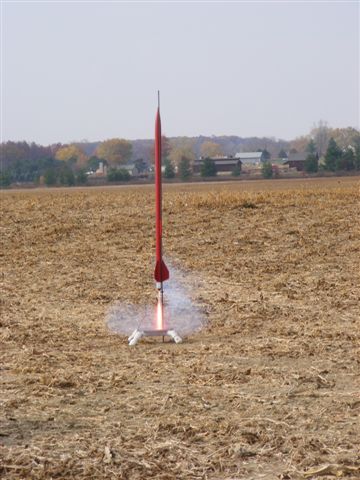
When deciding to become a novelist while keeping the day job – sadly necessary if you also choose to live in a house and eat food – you have to be willing to give up most of your hobbies, or at least the most time-consuming ones. In my case, that was modeling and high-power rocketry (HPR, for the uninitiated).
HPR is the grown-up version of the ubiquitous Estes model rockets some of you might have toyed with as kids. Typically the rockets are big enough, and engines powerful enough, to require FAA waivers which close the airspace to conflicting traffic. You also have to go through a certification process with one of the national hobby organizations.
“Red Death”, headed for 6,000′ AGL and Mach .90, never to be seen again.
If you’ve been hanging out at this blog for a while, you know I’ve been a rocket and space geek since I was a little kid watching Apollo missions on the old black-and-white TV. When I discovered high-power about ten years ago, it hooked me completely. Better Half was less excited but she at least tolerated it. And to be fair, it’s not cheap: the cheapest motors are around twenty bucks each, and that’s if you’re using a reloadable system which means you’ve already forked over a hundred for motor casings. Throw in medium- to high-tech materials (fiberglass, composites, etc) and electronics (those parachutes don’t deploy themselves at 10,000′) and stuff gets spendy in a hurry. I built a couple of fiberglass rockets and one partially with composites, and that’s about as techy as it got. Perhaps if I’d invested in an altimeter-controlled recovery system, I’d still have Red Death instead of it being carted off by winds aloft somewhere into the next county.
This project, on the other hand, looks to be a bit more complicated.
It’s essentially an open-source Mercury/Redstone vehicle, taking advantage of modern building materials and 50-odd years of acquired knowledge. If you’re looking for a challenging build, this might be it.



 Is there
  The first time I read about hypothesis (3), I was stunned that it hadn’t been advanced earlier: what if everyone who can communicate doesn’t because there’s a really good reason not to? Should we be carrying on like we’re in the ol’ Griswold Vacation Wagon, broadcasting our suburban-honky naivete to all the gang-bangers within earshot? Because if predators count on anything, it’s the prey’s ignorance that they’re being stalked.




 The Chiles Files