Under Power

SpaceShip Two finally had its first powered flight today, passing Mach 1 with a 16-second burn of its solid/liquid hybrid engine. The jury’s still out as to how much of a safety advantage that may be, but it sure does look cool:

To infinity and beyond!

As they say, a picture is worth a thousand words. And video is worth even more:

Lots more at Clark Lindsey’s place and New Space Journal.

UPDATE: In more mundane aerospace news, Boeing’s 787 is finally returning to service. That program’s been a massive Charlie-Foxtrot from the beginning, but I do have high hopes for this bird.

Weekly Nerd News

After being alternately busy, sick, and/or otherwise occupied, it’s time to catch up with blogworthy stuff. And since NASA’s apparently spending our hard-earned money etching pictures of their junk into the Martian dirt, maybe it’s time we caught up with what’s happening in the serious space industry…

Click to enlarge. I dare you.

First up: Round Two of commercial space’s ascendancy. Orbital Science’s Antares launcher just put its first payload into orbit last week.

Next up: SpaceX keeps raising the bar with the latest Grasshopper hover test. This time it hovered over 800′. Word is their next ISS mission will demonstrate 1st-stage return – no plans to actually land the thing, but they’ll work out the guidance and powered descent techniques to at least plant the thing where they want in the Atlantic.

Next-next up: Virgin Galactic plans to make SpaceShipTwo’s first powered flight next Monday, and figures they might as well go supersonic while they’re at it. It might just be more trademark Branson Bluster, but if so that particular horse is already out of the barn. It’ll either happen or it won’t. I can’t recall if SpaceShipOne did that its first time under power, but once that motor’s lit it’s a mighty short trip to Mach 1.

Not to take their thunder away (okay, maybe I am), but Michael Belfiore visited XCOR Aerospace and posts this profile. I hope both they and Virgin are successful, but have to admit I prefer XCOR’s approach as a more useful long-term system.

Finally: any good movies coming out? Darned if I can think of any

Once you go green, you never…whatever rhymes with green.

Relighting the Candle

If NASA’s Space Launch System ever moves beyond “Powerpoint Engineering”, it might just do so with an update of the massive F1 engines that powered the Saturn V. If Uncle Sam’s gonna throw my hard-earned tax money down a hole anyway, then I’m cool with this particular hole:

America: doing impossibly awesome $#!+ since 1776.

How we get there from here is described in a fascinating story at Ars Technica:

Even though the performance goals of the engine will be close to its predecessor, its manufacturing will be done through radically different methods. The Dynetics folks echoed Betts, Case, and Coates when reflecting on the F-1’s construction, making many of the same observations about the jaw-dropping amount of hand-done work in the old design. In the name of affordability and efficiency, modern manufacturing techniques will be brought firmly to bear on the new version.

Each Pyrios booster will feature a pair of F-1B engines, built with techniques that more resemble 3D printing than traditional casting or milling. The main combustion chamber and nozzle in particular will undergo tremendous simplification and consolidating; the parts count for those two assemblies together will be reduced from 5,600 manufactured elements in the original F-1 down to just 40.

Emphasis mine.

I have my doubts that this particular pig will ever fly, but if it leads to some serious R&D to perfect and cheapen an already heart-stoppingly powerful engine, then so much the better. With licensing and whatnot, somebody is bound to put it to good use.

Make It So

Just found this piece on NASA’s research into faster-than-light propulsion at Popular Science (yeah, I know: often not much better than the Weekly Reader from grade school, but such is today’s media) so I’ll only link. Deep thoughts later. Or not.

Having said that, at least someone at NASA gets it:

In the wake of the shuttle program’s termination and given the increasing role of private industry in low-Earth orbit flights, NASA has said it will refocus on far-flung, audacious exploration, reaching far beyond the rather provincial boundary of the moon. But it can only reach those goals if it develops new propulsion systems—the faster the better. A few days after the 100 Year Starship gathering, the head of NASA, Charles Bolden, echoed White’s remarks. “One of these days, we want to get to warp speed,” he said. “We want to go faster than the speed of light, and we don’t want to stop at Mars.”

If that “someone” happens to be the Administrator, then so much the better. Investigating advanced propulsion concepts and hands-on work like the Asteroid Capture Mission are precisely what a government space agency should be doing. Leave earth-orbit access to private business while helping us figure out how to go even farther.

In the 1920’s, when the U.S. Post Office needed to move large amounts of mail across the country quickly, they didn’t design, build, and operate their own airplanes: they hired out the job to a number of companies that eventually became household names. In particular, you know them as United, American, and the late-great Pan Am. These carriers gave us pioneering aviators like Charles Lindbergh and Elrey Jeppesen.

In other words: a space industry, not a space program.

Another Space Nerd Roundup

The Atlantic has a conversation with Eric Anderson of Space Adventures: The Coming Age of Space Colonization.

I remember this stuff being a big deal in the late 70’s; you couldn’t pick up a fanboy magazine without slogging through a lot of fanciful stories about how we by gosh were going to have a huge, impossibly advanced space colony within the next decade or so (Spin up the wayback machine: remember Omni and “L5 by ’95”? Admit it, already).

And in the “how to get there” category: CalTech Assigns Students to Design a Mars Mission, or at least to one of its moons.

Finally, closer to home: SpaceX Dragon Splashes Down, Completing CRS-2 Mission. This is becoming less and less newsworthy, which is a good thing.

Space Nerd News

Been a while since I’ve updated the blog (I’m largely staying away from the internet ’cause it keeps getting in the way of actually, you know, writing), but as promised here’s some links to interesting stuff:

Christian Science Monitor explores the pychological aspects of the Inspiration Mars effort. Short version: “Survivor” in space. Though I can think of a lot of “reality” TV stars that ought to be sent on a possible one-way mission to deep space. Like pretty much all of them. Buh-bye, media whores…

So how would they get there, anyway? Popular Mechanics has a nice overview of where things stand with commercial spaceflight: The Race to Cash in on Earth Orbit

And in not-unrelated news: Number of “City Killer” Asteroids “Very Large”, House Panel Told. As Professor Reynolds often quotes, “Asteroids are nature’s way of asking, ‘How’s that space program coming along?'”

UPDATE: Almost forgot, the brains behind Inspiration Mars have posted a response to Dennis Wingo’s analysis of their plan. Unfortunately it’s about what I expected: everybody loves the idea of a Venus-Mars flyby, but they’d have to be prepared to leave a good year ahead of the current schedule, which is ambitious enough already. An awful lot of tech currently in development would have to go just right for that to happen, and it sounds like they don’t want to bank on it.

Layovers

This whole “Inspiration Mars” free-return mission is getting a lot of well-deserved attention, and one analysis I stumbled into today is worth pointing out.

A recent piece by Dennis Wingo at SpaceRef offers what may look like some convoluted routes to Mars, except that the peculiarities of orbital mechanics actually reduce the trip time in some cases. Sixteen months in a flying RV would really be worth it if you could also fly by the Moon and Venus on your way around Mars. Seems to me if you’re going to go to all that trouble anyway, you might as well tailor the orbit to do just that.

So it’s not exactly like the airline’s around-your-@$$-to-reach-your-elbow routes. Cleveland to LA via New Jersey, for example, isn’t quite the same thing as Earth-Moon-Venus-Mars-Earth.

A human Grand Tour of the inner Solar System, paid for with private funds: this is the age I’ve been waiting for.

The downside is they’d have to be prepared to leave in 2017, not 2018. But if outfits like SpaceX can keep this up, they might just make it:

I don’t know who said it first, but I first saw this quote at Rand Simberg’s place: “It shouldn’t be NASA’s job to send men to Mars. It should be their job to make it possible for the National Geographic Society to send men to Mars.”

As they say, Nature abhors a vacuum. If NASA wasn’t going to do it, somebody was eventually going to step up.

Pack the Air Freshener

“I told you to go before we left!” Credit: SpaceX/NASA

In case you’re thinking about signing up for that Inspiration Mars trip, there’s a little something you should know…

Radiation is a substantial risk to humans once they’re beyond the protection of Earth’s magnetic field. There are lots of ideas for mitigating this, most of which involve some form of just rearranging the stuff they’d already have to bring with them. Food and water immediately come to mind, especially water. Since any water supplies on such a long-duration flight would have to continually recycled, we’d be talking about a fairly constant volume. But there is one other “value-added” radiation shield that would build up during the trip.

Can you think of what that might be? Anyone?

Hint: monkeys fling it.


APOGEE, Chapter 1

As promised, here’s the next round of Apogee sneak previews.

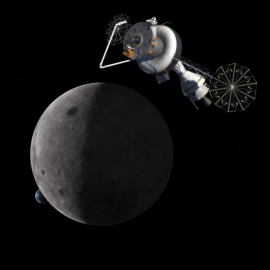
If ya’ll haven’t guessed, we pick up where Perigee left off: that is, with Art Hammond hell-bent on sending people around the Moon. The tech combines elements of Buzz Aldrin’s “lunar cycler” concept, Bigelow/Transhab type inflatable modules, L2 depots, and a few other things that I’ll try and surprise you with. The “LV” prefix before a ship’s name stands for “Lunar Vessel”, something I made up.

Hints and Spoiler Alerts: Remember that Ryan and Penny were both ex-military? That’s going to come back and bite them.

The excerpts posted here are from the first round of revisions. Details may change along the way, but the story arc and all that goes with it will not. Enjoy!

UPDATE: speaking of details…interesting how seeing something you’ve been looking at for months suddenly changes when you post it somewhere in a different format. There were some things about this first chapter that bugged me, so I’ve done a little editing. I think this flows a lot more nicely, hopefully you will too. Continue reading “APOGEE, Chapter 1”

Working On The Railroad

Funny, it doesn't LOOK golden...For those of you not familiar with the American history of Westward expansion (that wasn’t summed up in popular lore by an old Iron Maiden song), the “golden spike” refers to the completion of the first Transcontinental Railroad. It signified the opening of the West, and allowed us to transition from pioneering to something more permanent.

The railroad made life easier for settlers who before could only live off the land, and allowed more people from “Back East” to head West. A century later, this all provided rich fodder for Clint Eastwood movies, but that’s another story.

Today, “Golden Spike” also refers to a new company intent on getting people back to the Moon by the end of this decade.

Like everyone else in the space-nerd corner of the blogosphere, I’ve been eagerly awaiting today’s announcement (no, not the one for the new Trek movie – but hey, that works too). I hadn’t posted anything on it because recent rumors suggested that one of the company’s investors happens to be a gentleman whom I work for.

Sadly, it now appears those rumors aren’t true – because you’d better believe I’d have been all up in his office looking for a foothold in the new company.

Though it does appear to have signed up some serious investors and human spaceflight experts. It’s also nice to see that they’re pushing a framework along the lines of what I’d been holding to for a long time:

That is, rocket science ain’t exactly rocket science anymore. 

In particular, there are ways to get to the Moon that don’t necessarily demand a Saturn V-class launcher. If these guys are serious about a “cislunar superhighway”, then that presumably means they’re serious about orbital depots, reusable landers, and maybe even Aldrin cyclers.

Aldrin cyclers are – surprise – named for the second man to walk on the moon, Buzz Aldrin. He earned the first PhD in Orbital Mechanics from MIT, years before there was even a manned space program. His doctoral thesis in orbital rendezvous became NASA’s standard, especially after he and Jim Lovell were forced to prove the concept when their radar on Gemini XII failed.

Dr. Aldrin proposed a system of reusable spacecraft that would semi-permanently orbit between two bodies: in this case, Earth and Moon. They would be on long, low-energy orbits, maybe two weeks each way (recall that Apollo missions only took 3 or 4 days each way).  The idea is they would be constantly shuttling people and stuff between the two, and could be met by other spacecraft at either destination.

So instead of a crew needing a big one-way booster to lunar orbit, maybe they’d only need to get up to a high Earth orbit with their stuff and dock with the Cycler while it’s swinging by.

Of course nothing lasts forever up there, which is where the fuel depots come in. If that technology could be mastered (and a lot of really smart people think it could be, rather soon) then it opens up all sorts of possibilities: namely, smaller and more frequent launches. Reusable landers. Semi-permanent cyclers.

If it sounds like I’ve been thinking about this a lot, it’s because I have been. All of this cislunar-infrastructure-stuff (say that three times fast) is an integral part of the Perigee sequel, working title I Have No Freaking Idea What to Name This Book Yet. But I’m still leaning towards Terminal Velocity or maybe Farside Down.

In the meantime, I hope this group can put together enough money to actually do something but there’s a long, sad history in this business of people with grand ideas and no money. It’s certainly more plausible than just five or six years ago, and one encouraging aspect of today’s announcement is that no one’s laughing them out of the room: major newspapers, networks, and magazines are all featuring this story today.

That’s because Musk and SpaceX have shown us how it can be done. If they can drive down launch costs as much as they’re hoping for, then Golden Spike has a realistic chance to move this project beyond PowerPoint. Unless at least a few billionaires sign up to bankroll a flight, all of this is just neat-looking vaporware until they start putting money down for someone to bend metal.

No bucks, no Buck Rogers. Or so I’ve heard…