In Space, No One Can Hear Your Agent

NASA okays release of the first sci-fi movie actually filmed…wait for it…in spaaace!

But before anyone gets all excited and starts camping out in front of theaters, keep in mind it’s only eight minutes long.

You read that right. So it ain’t exactly Lord of the Rings. Maybe they can run it as a short ahead of the Phantom Menace 3D re-release. Not that I’d advise camping out for that one, either…

The Shoulders of Apollo

Andrew Chaikin is the author of A Man on the Moon, an eminently readable history of the Apollo program which Tom Hanks used as the basis for his HBO miniseries, From the Earth to the Moon.

The book reads like a novel. It’s hands-down the single best source of information on one of our nation’s greatest achievements, and provides excellent context for more detailed inside-baseball histories written later on by key players like Gene Cernan, Chris Kraft, and Gene Kranz.

They are all men whom I have a tremendous amount of respect for, and held high places among my list of boyhood heroes. But sadly, many of the men who made Apollo successful have also fully imbibed the NASA Kool-Aid, based on their advocacy for the atrocious Senate Space Launch System. SLS threatens to become a fiscal black hole from which no other program money will escape.  I found this ironic for Mr. Kranz, who in his own book, Failure is Not an Option, lamented as to how NASA has devolved into just another butt-covering government bureaucracy.

Which brings me back to Mr. Chaikin, who recently penned an excellent piece on the sorry state of U.S. human spaceflight in Space News. An unquestioned expert on Apollo history, he appears to have benefited from an historian’s sense of objectivity. It probably didn’t hurt that he wasn’t drinking from the water fountains in Houston or Canaveral in the ’60s, since they were apparently flush with the aforementioned Kool-Aid.

An excerpt:

Four decades later the challenge is not just to follow Apollo’s trail into deep space, but to do it affordably and sustainably. That’s not going to happen if NASA continues to be run as a jobs program as much as a space program.

These are the things I think about when I hear people like my manager friend say that commercial companies should be patient and wait for the fruits of NASA’s experience to spin off to the private sector. They apparently don’t see that this spinoff has already happened, that companies like SpaceX have digested the collected wisdom of NASA’s first half-century and are building on it.

But don’t take my word for it. Read the whole thing at Space News.

Snoopy Come Home

I don’t know if this project is comparable to finding a needle in a haystack. Maybe more like finding a particular grain of sand on a beach.

I’m a bit of a math geek but the prospect of finding a 42-year-old Lunar Module cast away to orbit the Sun boggles the mind. It can probably be done as we have a pretty good handle on orbital mechanics. Limiting the variables will be a problem. To my amateur’s mind, the big questions would be getting precise enough data on the LM’s orbital elements after they left it behind, and what kind of other weird cosmic effects may have pushed it around over the last four decades. Solar wind and gravity gradients are way beyond my layman’s knowledge.

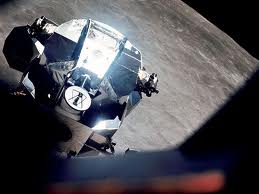
Apollo 10 was a dry run for the first landing mission, Apollo 11. Their orbit took them pretty darn close the the Moon’s surface, and they did everything but actually land. But even if the crew had grown a wild hair and decided to go for it, they would’ve been in for a long stay. The Lunar Module for the dry-run mission was used precisely because it was too heavy for a landing attempt. Grumman had embarked on an aggressive weight-reduction program for the landers, and apparently this one (LM-4, named “Snoopy” by the crew) didn’t make it to the scales in time.

But don’t feel too bad for the guys who almost made it. Two of the crew (Gene Cernan and John Young) ended up going back as mission commanders. Of the very few men who’ve been to the Moon, they’re part of the really select few who have done it twice. The third, Jim Lovell, flew around it twice on Apollo 8 and Apollo 13.

You’ve probably heard of that last mission. I would imagine his frustration at not landing was tempered by the relief of just getting back alive.

And in case you’re wondering, Apollo 10’s Command Module was named (you guessed it) Charlie Brown. Not sure where Lucy and Linus fit in here, but Snoopy actually has a long history with the space program, particularly during the 60’s when both the agency and the comic strip were at their heights. The Silver Snoopy is still a prized award within NASA ranks.
Zoom-Zoom

If you’ve ever wondered what Mach 20 looks like, check out this video of last week’s test of the Hypersonic Test Vehicle, HTV-2.

This is the kind of the kind of technology that populates the world of Perigee. There’s still a long way to go before anybody’s selling tickets, that’s for sure.

In the “What Do They Know That We Don’t?” Department…

DARPA is dropping a half-mil on feasibility studies for an interstellar spaceship.

Half a million is chump change in federal-budget terms, the stuff they pull out from under the seat cushions on Air Force One. So if they were spending, say, a half-trillion instead, that would make me wonder what might be out there and heading our way.

And while I think this is all kinds of cool, in the current environment it’s probably not the best use of public money.

Not that any considerations like that ever matter, of course.

UPDATE: It’s not paranoia if they really are out to get you! Here it is, proof of the massive Earth-destroying asteroid cover-up conspiracy thingy. Or not.