
Oh Goody

This explains a lot. Namely, why the voices in my head won’t shut up until I write their incessant babbling down on paper:

When the researchers looked specifically at authors, they found that they are overrepresented among people with schizophrenia, depression, bipolar disorder, anxiety syndrome, and substance abuse problems. Authors were also almost twice as likely to commit suicide as the general population.

Well, yeah. Spend years inventing a whole world inside your head, getting it into a readable form, and polishing it until every syllable flows across the pages like a rushing stream. Then you sweat blood whittling all that down into a three-sentence blurb and shotgun it out to agents and publishers, only to have them reject it. Sometimes rudely.

So you revise, edit, and do it all over again. Generally with better results, but still nothing that ends up with a publishing deal. Wash, rinse, repeat. Thank God for the rise of indie publishing, because a couple years of that query/reject/repeat cycle left me in a pretty sorry mental state.

At least now I have some control over the process and am making halfway decent money from my work. It’s still a hard slog, though. So if I don’t post anything for a while, it might be a good idea to send someone over to check on me.
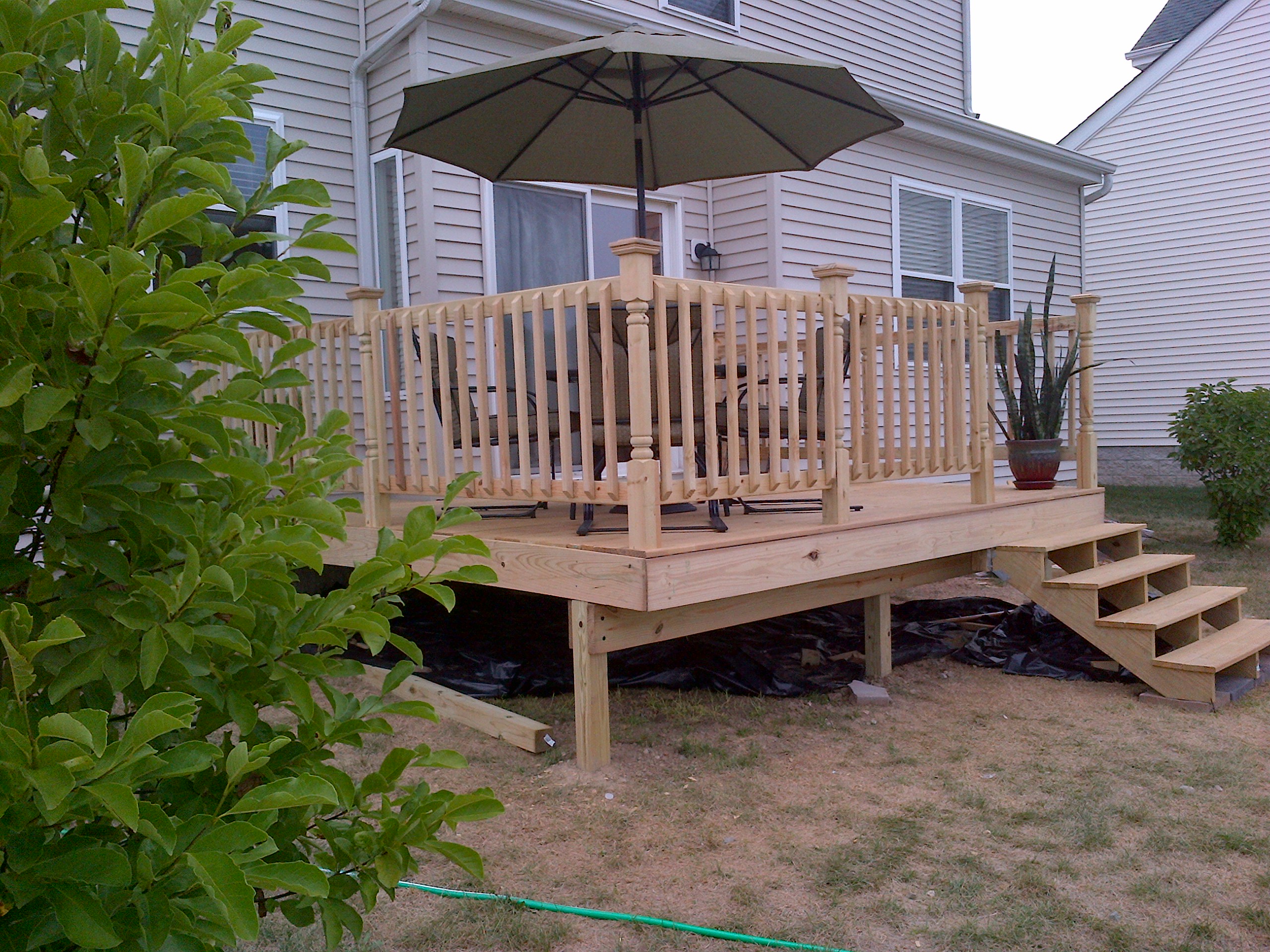
What I Did On Summer Vacation

Took on a construction job for no pay, that’s what. Behold:

The commanding perch of stately Chiles Manor.

Had to burn up some vaca before the end of the month, and we needed to replace the P.O.S 4×4 back porch that came with our house, so there you have it.

An aside: in what universe does it make sense to sell someone a $200K-plus home and slap a $50 porch off the back door? The dang thing was so ridiculously easy to tear down that I have a hard time believing it met any interpretation of local building codes.

Some other hard (ie: expensive) lessons from buying a new-build home:

– Even the so-called “upgrade” appliances suck @$$. Go to Lowes and buy them separately. No sense putting stuff that might last 10 years into a mortgage that lasts for 30.

– Ditto carpeting. And the “standard” carpets are apparently made of recycled dog blankets. Again: DIY w/ Lowes or Homie Depot.

– The interior paint jobs barely qualify as primer. Painting sucks, but not as much when there’s no furniture in the house, so do this yourself too.

End of lesson. So, on with the story…

I’m not much of a handyman. Especially when it comes to electrical or plumbing work – my stance has always been that if it can flood the house or burn it down, it’s worth paying a professional to handle.

But carpentry? Hey, what can go wrong with that?

Lots, actually. But this project mostly went by without trouble and only went over budget because we wanted nicer spindles and I bought the railings pre-assembled just to save time. Building in 100º weather forces those kinds of decisions.

But since this is a post about writing, perhaps I should meander back to the topic…

It was good to spend a week working with my hands, despite the heat. That kind of work clears the head in ways not too many other endeavors can. It forced me to focus on the task at hand, with attention to detail in every phase with a judicious amount of problem-solving along the way.

For nearly a week, I’ve not really given any thoughts to writing or marketing. That’s been a good thing. I’m dead-tired, sore from head to toe, and have a farmer’s tan that will probably be semi-permanent. But my mind is uncluttered and ready to get back to work.

Time to write.


Where Writers Go From Here

Via the Fantastical Andrew Fox: a far-reaching essay on the current state of literature (I’d say “publishing” but it’s so much more than that), where it’s going, and what it means for us ink-stained wretches who slave over our keyboards. It’s a long read but well worth it.

A couple of quick excerpts:

For the overwhelming majority of midlist writers, those without a history of best-selling books and those without a pre-existing “platform” of fame and public recognition, traditional publication by a large publishing house will be (and, for the most part, already is) a fading dream, a “winning the lottery” type of event. Most of us are simply going to have to do a whole lot more of the business end of things ourselves, if we hope to attain any presence in the literary marketplace. By the business end, I mean publicity, reader outreach, editing, and book design.

. . .

I think many writers enjoy helping other writers. I think this is so because writers were readers before they ever became writers, and thus learned to cherish other writers, and because writing is a solitary, lonely business and many writers hunger for a community of their fellow enthusiasts. I think as it becomes more and more crucial for us to assume greater responsibilities for the business side of our writing careers, it behooves the more successful among us to help our less fortunate, less resource-endowed fellow writers to pull themselves up by their proverbial bootstraps. Because we will benefit as readers and potentially as business people, and because creating community is a source of joy and fulfillment.

Yes. In a sense we’re all in competition with each other, but I don’t think most of us see it that way. Readers are always looking for good books, and they’re always looking for that one that hits the perfect notes – the one that makes the reader think “I must have this book”. Might be something of mine, then again it might not be. More power to ’em. Every single “name” writer I’ve been in contact with has been tremendously helpful, and I fully intend to follow in their footsteps. This is a tough business to break into, though it’s admittedly easier with e-publishing to a certain point…once your work’s out there, it’s all you, buddy. Be prepared to endure the slings and arrows, because we each stand or fall on our own talents.


The Prodigal Son Returns

Admittedly that stretches the analogy too far, but it makes for a good headline at least. Hey, you’re here reading this, right?

If you’ve not read Boyd Morrison’s work (and I highly recommend The Ark), he was the first Kindle author to hit the big time with a legacy publishing deal. Therefore he’s been a major influence and inspiration – not to mention he writes really fun books where engineers save the day. Continue reading “The Prodigal Son Returns”

Brazen Blogger Bait

This review, among other reasons, is why I’m a Sarah Hoyt fan even though I’ve yet to read her novels. Yeah, yeah, I know…but there hasn’t been a lot of time for reading other people’s work until very recently. I’ve likewise heard really good things about Ric Locke’s Temporary Duty and need to get off my @$$ and download a copy. I can only hope that Perigee merits similar praise from other writers at some point.

It’s immensely gratifying to read a traditionally published novelist who is not afraid to give a shout-out to an indie author. We could use a good deal more of that. It bugs me that associations like ITW and SFWA are closed to indie writers, except for an “associate” membership. In SFWA’s case, we appear to be shut out entirely. And judging by some of her other posts, maybe it’s just as well.

I get that there has to be some kind of standard, otherwise any schmuck who can pound out 300 pages of gibberish and have his first-grader cobble together a cover would be sharing equal status with names like DeMille, Preston and Child. But considering the rapidly-changing publishing landscape, shouldn’t there be some minimum sales threshold that would allow indie authors into the Cool Kid’s Clubs? Pick a number, it doesn’t matter to me…5,000? 10,000? And I would totally get excluding giveaway copies. That’s a marketing tactic, not a career plan.

A friend of mine who’s been quite successful in the Christian SF market once told me that the large majority of novels don’t sell more than about 1,500 copies.

Well, guess what? I’ve already passed that mark, and it doesn’t include the free promos used to goose sales on Amazon. Maybe I’ll just have to go and form my own club. As indie writers, we have a special responsibility to ensure our work is every bit as good as what comes out of the New York collective.

Assuming your book is worth reading, as writers we are all competing for readers in two fundamental ways: Name Recognition and Price Point. As a new indie author I have exactly zip in name recognition, which leaves me with pricing. This can be a tremendous advantage since it’s entirely under my control. I can respond to market trends much faster than any of the Big 6 ever could. But I can’t stress enough that we must put out Big 6-quality work, otherwise the indie revolution will end up being just another bubble.

I’m confident that a free market will sort that out. Nobody wants to buy crap, even for 99 cents.

It kills me to let Perigee go so cheaply, but that price seems to keep it moving. It won’t make me rich, but it has kept my own title listed among the ranks of Konrath, Clancy, and King. And right now, that’s pretty much ball-game. Build a reputation from the first book, and a career from all the rest.