Cool Your Jets

Reaction Engines in the UK seems to be excited about something:

The Biggest Breakthrough in Propulsion Since The Jet Engine

Can you tell they might think this is a big deal? I for one hope they’re not exaggerating because this does have the potential to be a generational leap in engine technology.

If their pre-coolers can be made to work outside the lab, then the concept of airbreathing rockets (or rocket-based combined cycle, RBCC) isn’t so farfetched anymore. And cooling a fast-moving mass of air by over 1,000°C in a hundredth of a second ain’t no small potatoes.

Take a look at this cutaway view of their SABRE engine: the heat exchangers are those baffled rings between the inlet spike in front and the compressor in the middle. It’s meant to function like the intake of a normal jet engine – but at hypersonic speeds, temperature becomes more limiting than just about anything else (presumably the inlet spikes are managing the shock waves that are just itching to bounce around inside that engine while it’s moving through the air at Ludicrous Speed).

So anyways, air tends to get kind of hot when it’s being pushed and squeezed at high velocities. And when air gets really hot, jet intakes tend to not work very well. That was a big reason the SR-71 was limited to around Mach 3.5 (or so they say). For a combined-cycle engine, precoolers are pretty much ball game.

SABRE engine. Credit: Reaction Engines UK

A functioning SABRE engine would enable the kind of suborbital spaceplanes that I wrote about in Perigee. In fact, Reaction’s ideas were used extensively in my mental world-building while the story took shape. I’m a big believer in the potential for suborbital point-to-point airline service – if you’d be willing to spend a quarter-mil for a 30 minute joyride on Virgin Galactic, wouldn’t you spend that much to actually go somewhere?

Yes, I’m kind of excited about this. Could it eventually lead to a single-stage-to-orbit spaceplane like they propose with Skylon? Maybe. The energy needed to make orbit is exponentially greater than that needed for a 6,000 mile hop at Mach 10.

Skylon spaceplane. Credit: Reaction Engines UK

So my answer would be, “beats me, ask a real engineer.” I just play one at work. But hanging those heavy engines out on the ends of the wing strikes me as not being a real good idea. Any twisting moments (which will happen in atmospheric flight) would just be amplified. Which means beefier wing structure, which adds weight, which increases minimum runway, which also requires more power from the engines, etc…this is the kind of circular reasoning that is otherwise known as a “trade study.” Every decision about one aspect of a system’s design affects all sorts of other stuff in the system. This is especially true in aeronautics.

But perhaps the biggest hurdle to overcome (in my view) is the apparent operating assumption that a passenger-carrying version of Skylon wouldn’t have a pilot aboard. They’d just pop in a passenger cabin, program the airplane, and send it on its way. There has been a tremendous amount of progress in the UAV world, but I have a hard time seeing how people would pay big money for an inherently risky ride with nobody up in the front office to deal with stuff when it all goes sideways. I have an even harder time seeing how FAA or EASA would ever certify such a bird to carry passengers (and that’s coming eventually, we can be certain). Unexpected bad stuff will happen, you can bet on it: flying is hours of boredom interrupted by moments of sheer terror. Thus shall it ever be.

11/30 UPDATE: io9 has more, but it sounds like they’re confusing Skylon with another Reaction proposal called LAPCAT.

12/01 UPDATE: Wired is on the case as well.

Warped Minds

NASA’s latest project under construction. You wish.

Maybe Elon Musk isn’t thinking big enough?

A few months ago, physicist Harold White stunned the aeronautics world when he announced that he and his team at NASA had begun work on the development of a faster-than-light warp drive. His proposed design, an ingenious re-imagining of an Alcubierre Drive, may eventually result in an engine that can transport a spacecraft to the nearest star in a matter of weeks — and all without violating Einstein’s law of relativity.

I’ve heard about this kind of research off-and-on for some time, and have to admit I thought it was nuts. But if it’s actually within reach of current technology (namely, enough energy to power such a thing) then, yeah. That’s the sort of out-there R&D that NASA ought to be working on, because new technology pretty much always starts with a lab experiment:

What White is waiting for is existence of proof — what he’s calling a “Chicago Pile” moment — a reference to a great practical example.

“In late 1942, humanity activated the first nuclear reactor in Chicago generating a whopping half Watt — not enough to power a light bulb,” he said. “However, just under one year later, we activated a ~4MW reactor which is enough to power a small town. Existence proof is important.”

Once the underlying science is understood, it becomes an engineering problem. And that’s where the really cool stuff gets done.

11/29 UPDATE: Warp Drive goes all respectable-like in the Atlantic Monthly.

Told You So, Part 2

Elon Musk is serious about going to Mars:

Musk’s $500,000 ticket price for a Mars trip was derived from what he thinks is affordable.

“The ticket price needs to be low enough that most people in advanced countries, in their mid-forties or something like that, could put together enough money to make the trip,” he said, comparing the purchase to buying a house in California. [Photos: The First Space Tourists]

He also estimated that of the eight billion humans that will be living on Earth by the time the colony is possible, perhaps one in 100,000 would be prepared to go. That equates to potentially 80,000 migrants.

Musk figures the colony program — which he wants to be a collaboration between government and private enterprise — would end up costing about $36 billion. He arrived at that number by estimating that a colony that costs 0.25 percent or 0.5 percent of a nation’s gross domestic product (GDP) would be considered acceptable.

The United States’ GDP in 2010 was $14.5 trillion; 0.25 percent of $14.5 trillion is $36 billion. If all 80,000 colonists paid $500,000 per seat for their Mars trip, $40 billion would be raised.

“Some money has to be spent on establishing a base on Mars. It’s about getting the basic fundamentals in place,” Musk said. “That was true of the English colonies [in the Americas]; it took a significant expense to get things started. But once there are regular Mars flights, you can get the cost down to half a million dollars for someone to move to Mars. Then I think there are enough people who would buy that to have it be a reasonable business case.”

Here’s a link to his full interview with the Royal Aeronautical Society (H/T Clark Lindsey’s NewSpace Watch). This bit is also interesting:

Musk also ruled out SpaceX’s Dragon capsule, which the company is developing to ferry astronauts to and from low-Earth orbit, as the spacecraft that would land colonists on the Red Planet. When asked by SPACE.com what vehicle would be used, he said, “I think you just land the entire thing.”

Asked if the “entire thing” is the huge new reusable rocket — which is rumored to bear the acronymic name MCT, short for Mass Cargo Transport or Mars Colony Transport — Musk said, “Maybe.”

Not sure why you’d want to land the whole thing on Mars, unless the booster can be used again for departure. That’s a bit of a departure from their earlier concepts, in which Dragon was designed as a true multi-purpose vehicle, up to and including Earth re-entry at Mars return velocities.

And did anyone else notice the MCT speculation? Hmm…

Told You So

MCT = Mars Crew Transport

Wired recently interviewed Elon Musk about why he founded SpaceX and his long-term goal of settling Mars:

Anderson: And Dragon, the spacecraft you berthed with the ISS in May, has features that might eventually prepare it for a manned Mars mission.

Musk: Eventually, yes. The thrusters on Dragon are sized so they’ll be able to do launch escape—which means being able to move away from the rocket at a force of approximately 6 g’s. That same thrust level happens to be kind of a good number for supersonic retro-propulsion for landing on Mars.

There’s also a lot of myth debunking and bubble-bursting contained within, particularly in regards to the conventional wisdom on rocket construction and launch economics. But wait, there’s more!

Musk: Version two of Dragon, which should be ready in three years, should be able to do it. But really, if humanity is to become multi-planetary, the fundamental breakthrough that needs to occur in rocketry is a rapidly and completely reusable rocket. In the absence of that, space transportation will remain two orders of magnitude more expensive than it should be…

…I’d like to emphasize this is an aspiration for SpaceX—I’m not saying that we will do it. But I believe it can be done. And I believe that achieving it would be on a par with what the Wright brothers did. It’s the fundamental thing that’s necessary for humanity to become a space-faring civilization. America would never have been colonized if ships weren’t reusable.

By all means read the whole thing.

Coincidentally, here’s the recent hover flight of their Falcon 1-based “Grasshopper” booster.

H/T: Clark Lindsey at NewSpaceWatch

Deep Space Whine

Deep-Space Vehicle concept. Credit: NASA

This Aviation Week story describes a “Deep Space Habitat” engineering mock-up built from old Space Station components before it meanders off into another eye-glazing discussion of Space Launch System, J2X engines, advanced solid boosters, and other pieces of flight hardware that will likely never make it to the launch pad. Oh, and unicorns. With rainbows.

Yes, I’m venting. This concept (the vehicle, not the venting) isn’t entirely new, so at least NASA gets credit for putting some hardware together to actively study the concept instead of consigning it to PowerPoint Purgatory. And the flight-ready items already exist as ISS modules that never made it to their intended destination. Far as I know, they’re still taking up space in Houston.

Sounds great. But having said that, what’s the likelihood of DSH becoming a reality? Because in all honesty I’d love to see it. This is exactly the kind of stuff NASA should be doing: pushing boundaries, exploration…and all the R & D work that goes along with it. But why oh why do we insist on them building another Big Dumb Booster to get the crap up there? Why do we insist on throwing that money down a hole instead of using it to build something really useful like DSH? Or for that matter, developing a couple of different propulsion options to push the thing around?

If you wanted to build a new boat, would you also feel the need to design a new flatbed truck from scratch just to get said boat to water? Because that’s pretty close to what we’re talking about here.

Couldn’t these modules be lofted into orbit by a Delta IV or Falcon 9 heavy? Couldn’t Orion, for that matter, if it’s being flight tested on a Delta IV-Heavy anyway?

Perhaps there’s a good reason they can’t but it’s hard to think of. Then again, why not just buy space on a manned Dragon once they’re available?

And while I’m aware it sounds like I’m all rah-rah fanboy over SpaceX, in truth they’re just at the leading edge of a new industry about which I am very enthusiastic. By all means cheer them on, as more are sure to follow (Blue Origin looks particularly interesting).

Maybe these frustrations will solve themselves as the “old model” of space exploration plods along. It’ll inevitably be leapfrogged by the private sector, at which point there will be no choice but to recognize the paradigm has already shifted.

In the meantime, something like this deep-space hab concept will be featured prominently in the sequel to Perigee, wherein stuff’s about to get real

Does MCT = Falcon XX?

A commenter in the last post on SpaceX’s “MCT” announcement included a link to this graphic:

Thanks Adros47! And…DA-YUM. Those things are monsters.

I dug a little more and found the full article from 2010 at Spaceref here. It includes an embedded link to another piece at Aviation Week, but the link seems to have expired. I’ll keep rooting around the interwebs and will post more if I find it.

And for the record, I’m standing by my “Mars Crew Transport” statement:

Unveiling conceptual plans for a family of Falcon X and XX future heavy-lift vehicles at last week’s AIAA Joint Propulsion conference here, SpaceX McGregor rocket development facility director Tom Markusic said, “Mars is the ultimate goal of SpaceX.”

Yeah, what he said!

UPDATE: Lots of talk about this at NASASpaceflight.com, and not all of it’s nice. Plenty of honest speculation, sprinkled with a healthy dose of carping and pedantic nitpicking. But do check out the back-of-the-envelope specs in a pdf at the linked post.

Also sounds like “MCT” refers to the engine, not the launcher itself. Which might throw cold water on my “Mars Crew Transport” theory. I’m also reminded that they frequently referred to their Saturn V – class ideas as “BFR”. Which I guess means Big Fuzzy Rocket. Or something like that…


More Spacey Goodness

Blue Origin, the Other Private Space Company Founded By An Internet Bazillionaire™, made news today as well:

NASA Commercial Crew Partner Blue Origin Completes Rocket Engine Thrust Chamber Test

NASA’s Commercial Crew Program (CCP) partner Blue Origin has successfully fired the thrust chamber assembly for its new 100,000 pound thrust BE-3 liquid oxygen, liquid hydrogen rocket engine. As part of Blue’s Reusable Booster System (RBS), the engines are designed eventually to launch the biconic-shaped Space Vehicle the company is developing.

Successfully testing the thrust chamber for a 100,000 lbf rocket engine is not small potatoes.

Blue Origin didn’t get anything from the latest round of CCDev funding, but I’m not sure they were all that interested either. Jeff Bezos seems content to keep things going all on his own, and I have to admit to a bit of fanboy enthusiasm for these guys. Being an indie author, the opportunities he created through Amazon will always hold a special place in my heart for obvious reasons.


What’s SpaceX Up To?

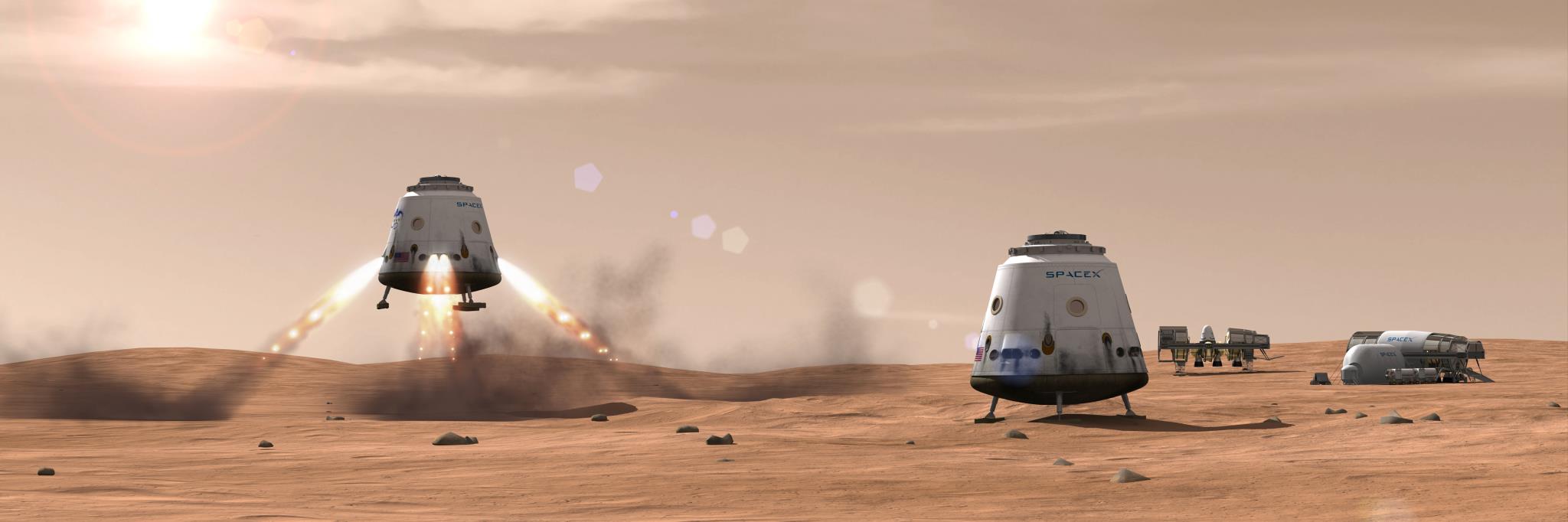
Dragon landing on Mars. Credit: SpaceX

As if manned space capsules and reusable boosters weren’t enough…but what is “MCT”? Some tantalizing bits from Flight Global:

Musk said the new rocket, which he calls MCT, will be “several times” as powerful as the 1 Merlin series, and won’t use Merlin’s RP-1 fuel. Beyond adding that it will have “a very big core size”, he declined to elaborate, promising more details in “between one and three years”.

Musk declined to say what ‘MCT’ stands for, and declined to answer further questions on the project.

During an April interview, SpaceX president Gwynne Shotwell discussed a project with similar characteristics, describing engines with “more than 1.5 million pounds” of thrust.

That would be equivalent to the behemoth F-1. With multiple engines arranged in a booster core 21 meters in diameter, that’s a bigger vehicle than the Saturn V.

Now for the really important part:

Shotwell said a possible payload range of the new rocket is 150-200t to low Earth orbit (LEO). A vehicle of that size would easily eclipse NASA‘s proposed Space Launch System, which will eventually be capable of launching 130t to LEO, making SpaceX’s potential vehicle the most capable ever built by a wide margin.

Note the low side of that estimate is 150 metric tons to LEO, compared to the Saturn’s throw weight of a shade less than 130mt. I’m excluding SLS because it will probably never evolve beyond vaporware.

Ho-lee crap. So, connecting the dots, SpaceX is developing a heavy booster that will be bigger and more capable than a Saturn V. Given their track record so far, I’ve no reason to doubt their success. Mr. Musk has hinted at this in the past, noting that Falcon 9-Heavy would not be the end of the line for them. Considering his oft-stated long term goals, I’ll risk future embarrassment and take a guess at what “MCT” might stand for:

Mars Crew Transport.

You heard it here first.

Leaving Home

35 years after its launch, has Voyager 1 finally left the solar system? It’s not as clear-cut as you might think: cross Pluto’s orbit, the Kuiper Belt (where I guess Pluto technically belongs), and even the Oort Cloud (from where comets come), and you’re still not there.

Barriers still have to be crossed, essentially signals that its leaving the Sun’s bubble of charged particles. The problem is that we don’t know precisely where they are, but there are some telltale signs:

Two of three key signs of changes expected to occur at the boundary of interstellar space have changed faster than at any other time in the last seven years, according to new data from NASA’s Voyager 1 spacecraft.

For the last seven years, Voyager 1 has been exploring the outer layer of the bubble of charged particles the sun blows around itself. In one day, on July 28, data from Voyager 1’s cosmic ray instrument showed the level of high-energy cosmic rays originating from outside our solar system jumped by five percent. During the last half of that same day, the level of lower-energy particles originating from inside our solar system dropped by half. However, in three days, the levels had recovered to near their previous levels.

A third key sign is the direction of the magnetic field, and scientists are eagerly analyzing the data to see whether that has, indeed, changed direction. Scientists expect that all three of these signs will have changed when Voyager 1 has crossed into interstellar space.

No word on if it’s encountered Klingons yet. Not that they’d tell us anyway…

The Klingon Empire meets Voyager. “Today is a good day to die.”

News From The Fuuuuture

In the latest edition of USA Today:

“Colorado has received a $200,000 federal grant to investigate building a spaceport east of the city, the Fort Collins Coloradoan reported. Backers say space travel could cut trip time between Denver and Australia from 20 hours to five.”

Being USA Today, it’s pretty light on details so I decided to go to the source. There’s nothing on the Ft. Collins paper’s website, but the Denver Post is on top of it.

I also don’t know where they get that five-hour figure. That’d be an average of Mach 3 or so; the speeds you’d need for a suborbital hop of that distance would easily be double.

Denver to Australia, through space? That’s crazy talk! Whoever would come up with such an outlandish idea? Really, somebody should write a book about it!